
Games of Chance vs. Games of Skill: Luck, Practice, and Control
A lucky beginner can sometimes defeat an expert. That possibility often creates confusion about whether a game is controlled by chance or skill.
A single unexpected result does not necessarily define the entire game. An inexperienced chess player may win when an expert makes a serious mistake, but repeated performance usually reveals a major difference in ability.
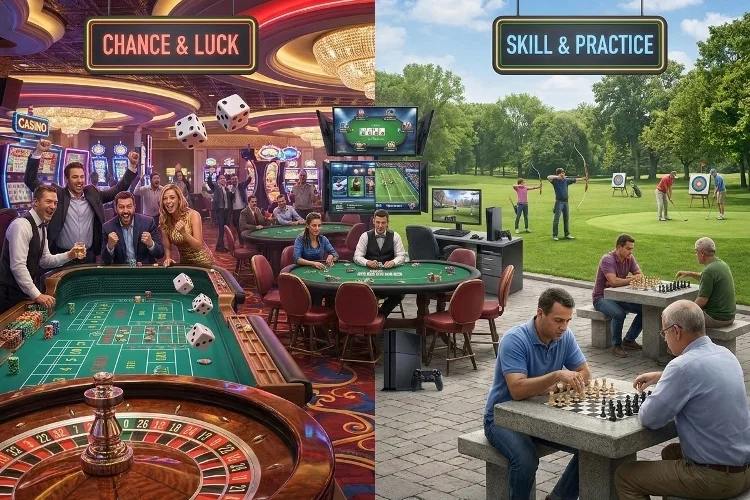
In roulette, by contrast, years of practice cannot give a player control over the pocket in which the ball lands.
The debate over games of chance vs. games of skill becomes more complicated when both elements appear together. Card games, fantasy competitions, video games with random rewards, and skill-based casino machines may require decisions while still producing uncertain outcomes.
A practical way to understand the distinction is to examine three factors: how results are generated, whether practice improves performance, and whether stronger participants consistently outperform weaker ones.
These questions are useful for education, but legal classifications remain dependent on local regulations and may not match everyday descriptions.
Randomness Creates Uncontrolled Outcomes
Chance refers to an event that the participant cannot reliably control or predict. Examples include a shuffled card, a dice roll, a randomly drawn bingo number, or an outcome generated by approved software.
Regulated random-number generators are expected to produce statistically random results. They must not secretly adjust a future outcome merely because a player has recently won or lost.
This independence explains why previous roulette spins do not reveal the next result. Five red outcomes in a row do not force the following spin to land on black.
Skill Creates Repeatable Advantages
Skill appears when knowledge or ability changes the probability of success. A chess player can learn openings, identify tactical patterns, and improve endgame decisions.
Physical games may test coordination, accuracy, speed, or endurance. Mental games may depend on calculation, memory, judgement, or strategic planning.
A useful test is repeatability. When the same highly trained participants regularly outperform beginners across many contests, skill is probably playing an important role.
A genuine prize competition should require enough knowledge, judgement, or ability to prevent at least some entrants from winning.
The Spectrum Between Pure Chance and Pure Skill
Rather than using only two boxes, it is more accurate to imagine a scale. Lotteries sit close to the chance end, while chess is close to the skill end.
Backgammon, poker, blackjack, and many fantasy competitions occupy the middle. Participants make meaningful choices, but dice, cards, injuries, or other unpredictable events influence the final outcome.
Researchers have developed mathematical methods to estimate the contribution of luck and expertise. One study examining chess, poker, and backgammon found that conclusions can depend on the benchmark used to define when skill becomes dominant.
Therefore, “contains skill” and “predominantly determined by skill” are not necessarily the same statement.
Poker Shows Why Classification Is Difficult
Poker players receive cards randomly, but they also manage information, betting decisions, risk, and opponent behavior.
A strong player may fold weak situations, extract more value from favorable hands, and avoid costly emotional decisions. These abilities may improve long-term performance.
Nevertheless, even an excellent player can lose with a statistically strong hand. Randomness remains highly visible in an individual deal.
Legal interpretations consequently differ. The UK Gambling Commission treats poker as a game of chance for the purposes of British gambling law, even though it recognizes that the game contains skill.
Blackjack Combines Strategy With Random Cards
Blackjack allows players to make choices such as hitting, standing, doubling, or splitting. Those decisions can affect the expected value of a hand.
However, a correct decision does not guarantee a successful result. A player may stand on a mathematically reasonable total and still lose when the dealer completes a stronger hand.
Regulatory standards recognize this relationship. When a gambling product includes skill, its theoretical return may be calculated using an automatic or published standard strategy.
This illustrates an important principle: skill can improve decision quality without giving the player control over every outcome.
Practice Helps Only When Decisions Matter
Practice is valuable when a game offers information that can be studied and choices that can be improved.
A poker player can review betting patterns. A chess player can analyze previous mistakes. A competitive gamer can improve reaction time and map knowledge.
Practice cannot alter an independent lottery draw or force a slot machine to produce a particular symbol combination. Learning how these products work may prevent false beliefs, but it cannot create control where none exists.
Random games achieve their theoretical return through large numbers of outcomes, not by ensuring that every participant receives a particular percentage during a session.
Why Players Often Overestimate Skill
People naturally remember successful predictions and may forget unsuccessful ones. This can create an illusion that a personal system is influencing a random game.
Choosing a roulette number, pressing a slot button, or throwing dice personally may feel like control. The physical action does not necessarily affect the underlying probability.
Skill-based features can also make gambling products feel less random than they are. Research has examined electronic gambling machines that combine player actions with chance-based rewards, highlighting the need to distinguish genuine performance effects from decorative interaction.
Chance and skill are not always opposites. Many games contain both, and the dominant influence may change depending on whether results are measured over one round or thousands of contests. Roulette and lotteries leave almost no meaningful control to the participant.
Chess rewards sustained learning, while poker and blackjack combine strategic choices with uncertain cards.
Before calling a game skill-based, ask whether training produces a consistent advantage and whether decisions genuinely change the likelihood of success. Do not confuse interaction with control or strategy with guaranteed profit.
Paid games can still involve fees, unfavorable odds, and significant losses. Study the rules, verify local regulations, and decide in advance how much time or money you are prepared to spend.